

Which Three Technical Services Support Cloud Computing
What is cloud computing?
Cloud computing is a general term for anything that involves delivering hosted services over the cyberspace. These services are divided into three chief categories or types of cloud computing: infrastructure as a service (IaaS), platform equally a service (PaaS) and software as a service (SaaS).
A deject tin can be private or public. A public cloud sells services to anyone on the net. A individual deject is a proprietary network or a data center that supplies hosted services to a limited number of people, with certain admission and permissions settings. Individual or public, the goal of deject calculating is to provide easy, scalable admission to computing resources and IT services.
Cloud infrastructure involves the hardware and software components required for proper implementation of a cloud computing model. Cloud calculating tin too be idea of every bit utility computing or on-demand calculating.
The name cloud computing was inspired past the cloud symbol that'southward often used to represent the internet in flowcharts and diagrams.
How does cloud computing piece of work?
Cloud computing works by enabling client devices to admission data and cloud applications over the cyberspace from remote concrete servers, databases and computers.
An internet network connection links the front end, which includes the accessing customer device, browser, network and cloud software applications, with the back end, which consists of databases, servers and computers. The dorsum stop functions as a repository, storing information that is accessed by the front terminate.
Communications between the front and dorsum ends are managed by a central server. The key server relies on protocols to facilitate the commutation of data. The primal server uses both software and middleware to manage connectivity betwixt different client devices and cloud servers. Typically, at that place is a dedicated server for each individual application or workload.
Cloud calculating relies heavily on virtualization and automation technologies. Virtualization enables the easy abstraction and provisioning of services and underlying deject systems into logical entities that users can asking and utilize. Automation and accompanying orchestration capabilities provide users with a high degree of self-service to provision resources, connect services and deploy workloads without directly intervention from the cloud provider'south Information technology staff.
Types of cloud computing services
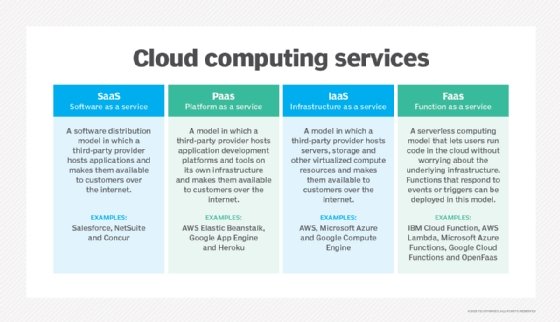
Cloud computing tin be separated into three full general service delivery categories or forms of cloud computing:
- IaaS . IaaS providers, such every bit Amazon Web Services (AWS), supply a virtual server instance and storage, besides as awarding programming interfaces (APIs) that permit users migrate workloads to a virtual machine (VM). Users have an allocated storage capacity and tin start, finish, access and configure the VM and storage as desired. IaaS providers offering small, medium, large, extra-large, and memory- or compute-optimized instances, in addition to enabling customization of instances, for various workload needs. The IaaS cloud model is closest to a remote data center for business users.
- PaaS . In the PaaS model, cloud providers host development tools on their infrastructures. Users access these tools over the internet using APIs, web portals or gateway software. PaaS is used for general software development, and many PaaS providers host the software later on information technology's developed. Common PaaS products include Salesforce'south Lightning Platform, AWS Elastic Beanstalk and Google App Engine.
- SaaS . SaaS is a distribution model that delivers software applications over the net; these applications are often called web services. Users tin access SaaS applications and services from any location using a computer or mobile device that has internet access. In the SaaS model, users proceeds access to application software and databases. One common case of a SaaS application is Microsoft 365 for productivity and email services.
Cloud computing deployment models
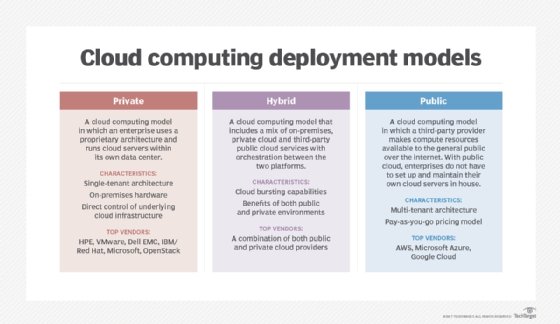
Individual cloud services are delivered from a concern'south data heart to internal users. With a individual cloud, an organization builds and maintains its own underlying deject infrastructure. This model offers the versatility and convenience of the cloud, while preserving the management, command and security common to local data centers. Internal users might or might non exist billed for services through Information technology chargeback. Common private cloud technologies and vendors include VMware and OpenStack.
In the public cloud model, a third-party cloud service provider (CSP) delivers the cloud service over the cyberspace. Public cloud services are sold on demand, typically by the minute or hr, though long-term commitments are available for many services. Customers only pay for the central processing unit cycles, storage or bandwidth they eat. Leading public CSPs include AWS, Microsoft Azure, IBM and Google Deject Platform (GCP), also as IBM, Oracle and Tencent.
A hybrid cloud is a combination of public deject services and an on-premises private cloud, with orchestration and automation between the ii. Companies can run mission-disquisitional workloads or sensitive applications on the private deject and utilise the public cloud to handle workload bursts or spikes in demand. The goal of a hybrid cloud is to create a unified, automated, scalable environment that takes reward of all that a public cloud infrastructure can provide, while withal maintaining control over mission-critical data.
In addition, organizations are increasingly embracing a multi-cloud model, or the use of multiple IaaS providers. This enables applications to drift between different cloud providers or to even operate meantime beyond 2 or more cloud providers.
Organizations adopt multi-cloud for various reasons. For example, they could practise then to minimize the take a chance of a cloud service outage or to take advantage of more competitive pricing from a detail provider. Multi-deject implementation and application development can be a challenge considering of the differences between cloud providers' services and APIs.
Multi-cloud deployments should become easier, notwithstanding, as providers' services and APIs converge and get more than standardized through industry initiatives such as the Open Deject Computing Interface.
A customs cloud, which is shared by several organizations, supports a item community that shares the same concerns -- e.grand., the aforementioned mission, policy, security requirements and compliance considerations. A customs deject is either managed past these organizations or a third-party vendor and tin be on or off premises.
Characteristics and advantages of deject calculating
Cloud calculating has been around for several decades now, and today'southward deject computing infrastructure demonstrates an array of characteristics that have brought meaningful benefits for businesses of all sizes. Some of the principal characteristics of cloud computing are the following:
- Self-service provisioning . End users tin can spin up compute resources for almost any type of workload on need. An end user tin provision calculating capabilities, such as server fourth dimension and network storage, eliminating the traditional need for Information technology administrators to provision and manage compute resources.
- Elasticity . Companies tin can freely scale up every bit computing needs increment and scale down again as demands decrease. This eliminates the need for massive investments in local infrastructure, which might or might not remain active.
- Pay per use . Compute resource are measured at a granular level, enabling users to pay only for the resources and workloads they use.
- Workload resilience. CSPs often implement redundant resource to ensure resilient storage and to proceed users' important workloads running -- ofttimes across multiple global regions.
- Migration flexibility. Organizations can motility certain workloads to or from the cloud -- or to different cloud platforms -- equally desired or automatically for meliorate cost savings or to use new services as they emerge.
- Wide network admission. A user can access cloud data or upload data to the deject from anywhere with an net connexion using any device.
- Multi-tenancy and resource pooling. Multi-tenancy lets numerous customers share the same physical infrastructures or the same applications yet yet retain privacy and security over their own information. With resources pooling, cloud providers service numerous customers from the same physical resources. The resources pools of the deject providers should be large and flexible enough so they can service the requirements of multiple customers.
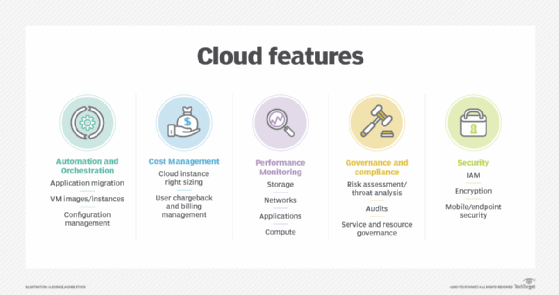
These characteristics back up a variety of important benefits for modern business organization, including the post-obit:
- Toll management. Using cloud infrastructure can reduce capital costs, as organizations don't accept to spend massive amounts of coin ownership and maintaining equipment. This reduces their majuscule expenditure costs -- as they don't have to invest in hardware, facilities, utilities or building large data centers to accommodate their growing businesses. Additionally, companies don't demand big IT teams to handle cloud data center operations because they can rely on the expertise of their deject providers' teams. Cloud calculating as well cuts costs related to downtime. Since downtime rarely happens in deject computing, companies don't have to spend fourth dimension and money to fix any bug that might exist related to downtime.
- Data and workload mobility. Storing data in the deject means that users can access it from anywhere with whatsoever device with just an internet connectedness. That ways users don't have to conduct around USB drives, an external hard drive or multiple CDs to admission their information. Users tin can access corporate data via smartphones and other mobile devices, enabling remote employees to stay upwards to date with co-workers and customers. Cease users can easily procedure, store, recall and recover resources in the deject. In add-on, cloud vendors provide all the upgrades and updates automatically, saving time and attempt.
- Business organisation continuity and disaster recovery (BCDR). All organizations worry about data loss. Storing information in the cloud guarantees that users can e'er access their data even if their devices, eastward.g., laptops or smartphones, are inoperable. With cloud-based services, organizations can chop-chop recover their data in the event of emergencies, such as natural disasters or power outages. This benefits BCDR and helps ensure that workloads and information are bachelor fifty-fifty if the business concern suffers impairment or disruption.
Disadvantages of cloud computing
Despite the clear upsides to relying on cloud services, deject calculating carries its own challenges for Information technology professionals:
- Cloud security . Security is oft considered the greatest challenge facing cloud calculating. When relying on the cloud, organizations run a risk data breaches, hacking of APIs and interfaces, compromised credentials and authentication issues. Furthermore, in that location is a lack of transparency regarding how and where sensitive information entrusted to the cloud provider is handled. Security demands conscientious attention to cloud configurations and business organisation policy and practice.
- Cost unpredictability . Pay-as-you lot-go subscription plans for cloud use, along with scaling resources to adjust fluctuating workload demands, can make information technology tough to define and predict final costs. Cloud costs are too oft interdependent, with one cloud service often utilizing 1 or more other cloud services -- all of which appear in the recurring monthly bill. This can create boosted unplanned cloud costs.
- Lack of adequacy and expertise . With deject-supporting technologies chop-chop advancing, organizations are struggling to keep upwards with the growing need for tools and employees with the proper skill sets and knowledge needed to architect, deploy, and manage workloads and data in a cloud.
- Information technology governance. The emphasis on do-it-yourself capability in cloud computing can make It governance difficult, equally at that place is no command over provisioning, deprovisioning and management of infrastructure operations. This can brand it challenging to properly manage risks and security, It compliance and data quality.
- Compliance with manufacture laws . When transferring data from on-premises local storage into cloud storage, it can be difficult to manage compliance with industry regulations through a third party. It's important to know where data and workloads are actually hosted in club to maintain regulatory compliance and proper business governance.
- Direction of multiple clouds . Every cloud is different, then multi-cloud deployments can disjoint efforts to accost more than general cloud calculating challenges.
- Cloud functioning . Performance -- such as latency -- is largely beyond the control of the arrangement contracting cloud services with a provider. Network and provider outages tin interfere with productivity and disrupt business processes if organizations are not prepared with contingency plans.
- Building a private cloud . Architecting, building and managing individual clouds -- whether for its own purpose or for a hybrid cloud goal -- can be a daunting task for Information technology departments and staff.
- Cloud migration . The process of moving applications and other data to a deject infrastructure often causes complications. Migration projects oft take longer than predictable and get over upkeep. The issue of workload and data repatriation -- moving from the deject dorsum to a local information middle -- is often overlooked until unforeseen cost or performance problems arise.
- Vendor lock-in. Frequently, switching between cloud providers can crusade significant problems. This includes technical incompatibilities, legal and regulatory limitations and substantial costs incurred from sizable data migrations.
Deject computing examples and use cases
Deject computing has evolved and diversified into a wide array of offerings and capabilities designed to suit nigh any conceivable concern demand. Examples of cloud calculating capabilities and diversity include the post-obit:
- Google Docs, Microsoft 365. Users can access Google Docs and Microsoft 365 through the internet. Users tin be more than productive considering they can access work presentations and spreadsheets stored in the cloud at anytime from anywhere on any device.
- Email, Calendar, Skype, WhatsApp. Emails, calendars, Skype and WhatsApp take advantage of the cloud'southward power to provide users with access to data remotely so they tin access their personal information on any device, whenever and wherever they want.
- Zoom. Zoom is a cloud-based software platform for video and audio conferencing that records meetings and saves them to the cloud, enabling users to access them anywhere and at any time. Another common communication and collaboration platform is Microsoft Teams.
- AWS Lambda. Lambda enables developers to run code for applications or dorsum-terminate services without having to provision or manage servers. The pay-as-you-become model constantly scales with an organization to suit real-time changes in data usage and data storage. Other major deject providers too support serverless computing capabilities, such equally Google Cloud Functions and Azure Functions.
So, how is the deject actually used? The myriad services and capabilities plant in modern public clouds have been applied across countless use cases, such as the following:
- Testing and development. Fix-made, tailored environments tin expedite timelines and milestones.
- Production workload hosting. Organizations are using the public cloud to host alive product workloads. This requires careful pattern and architecture of cloud resources and services needed to create an adequate operational environment for the workload and its required level of resilience.
- Big data analytics . Remote information centers through cloud storage are flexible and scalable and can provide valuable data-driven insights. Major cloud providers offer services tailored to big data projects, such as Amazon EMR and Google Cloud Dataproc.
- IaaS. IaaS enables companies to host Information technology infrastructures and admission compute, storage and network capabilities in a scalable way. Pay-as-you-get subscription models tin can help companies relieve on upfront IT costs.
- PaaS. PaaS tin can assistance companies develop, run and manage applications in an easier and more than flexible way, at a lower cost than maintaining a platform on premises. PaaS services can also increment development speed for applications and enables higher-level programming.
- Hybrid cloud. Organizations take the option to employ the advisable deject -- private or public -- for dissimilar workloads and applications to optimize price and efficiency according to the circumstance.
- Multi-cloud. Using multiple different deject services from separate deject providers can help subscribers observe the best cloud service fit for diverse workloads with specific requirements.
- Storage. Large amounts of data can be stored remotely and accessed easily. Clients only have to pay for storage that they actually employ.
- DR. Cloud offers faster recovery than traditional on-premises DR. Furthermore, it is offered at lower costs.
- Data backup. Cloud backup solutions are by and large easier to use. Users exercise not have to worry nearly availability and capacity, and the cloud provider manages data security.
Cloud computing vs. traditional web hosting
Given the many different services and capabilities of the public cloud, there has been some confusion between cloud computing and major uses, such equally web hosting. While the public cloud is frequently used for spider web hosting, the two are quite different. A deject service has three distinct characteristics that differentiate it from traditional web hosting:
- Users tin can access large amounts of calculating power on demand. It is typically sold past the minute or the hour.
- It is rubberband -- users can accept as much or every bit footling of a service as they desire at whatever given time.
- The service is fully managed past the provider -- the consumer needs nothing but a personal computer and internet access. Significant innovations in virtualization and distributed calculating, as well every bit improved admission to loftier-speed net, accept accelerated interest in cloud computing.
Deject calculating service providers
The deject service market place has no shortage of providers. The three largest public CSPs that have established themselves every bit dominant fixtures in the industry are the following:
- AWS
- GCP
- Microsoft Azure
Other major CSPs include the following:
- Apple
- Citrix
- IBM
- Salesforce
- Alibaba
- Oracle
- VMware
- SAP
- Joyent
- Rackspace
When considering a cloud service vendor, certain considerations should be taken. First, the bodily suite of services can vary between providers, and business concern users must select a provider that offers services -- such as big data analytics or artificial intelligence (AI) services -- that support the intended use case.
Though cloud services typically rely on a pay-per-apply model, different providers frequently have variations in their pricing plans to consider. Furthermore, if the cloud provider will exist storing sensitive data, physical location of the provider's servers should as well be considered.
Naturally, reliability and security should exist top priorities. A provider's service-level agreement should specify a level of service uptime that is satisfactory to client business needs. When considering dissimilar cloud vendors, shut attention should be given to what technologies and configuration settings are used to secure sensitive data.
Cloud calculating security
Security remains a main concern for businesses contemplating cloud adoption -- especially public cloud adoption. Public CSPs share their underlying hardware infrastructure betwixt numerous customers, as the public cloud is a multi-tenant environment. This environment demands pregnant isolation between logical compute resource. At the aforementioned fourth dimension, access to public cloud storage and compute resource is guarded past account login credentials.
Many organizations leap past complex regulatory obligations and governance standards are still hesitant to place information or workloads in the public cloud for fear of outages, loss or theft. However, this resistance is fading, equally logical isolation has proven reliable and the addition of information encryption and diverse identity and access management tools have improved security within the public cloud.
Ultimately, the responsibleness for establishing and maintaining a secure deject environment falls to the private business user that is responsible for edifice the workload's architecture -- the combination of cloud resource and services in which the workload runs -- and implementing the security features that the cloud provider offers.
History of cloud computing
The history and evolution of cloud calculating date back to the 1950s and 1960s.
In the 1950s, companies started to utilise large mainframe computers, but it was as well expensive to buy a estimator for each user. So, during the late 1950s and early 1960s, a process chosen time sharing was developed to brand more than efficient use of expensive processor time on the central mainframe.
Time sharing enabled users to access numerous instances of computing mainframes simultaneously, maximizing processing power and minimizing downtime. This idea represents the first utilise of shared computing resources, the foundation of modern deject computing.
The origins of delivering computing resources using a global network are, for the well-nigh function, rooted in 1969 when American computer scientist J.C.R. Licklider helped create the Avant-garde Enquiry Projects Agency Network, the so-called precursor to the cyberspace. Licklider's goal was to connect computers across the globe in a way that would enable users to access programs and information from any location.
In the 1970s, cloud computing began taking a more tangible shape with the introduction of the commencement VMs, enabling users to run more than 1 computing organization within a single physical setup. The functionality of these VMs led to the concept of virtualization, which had a major influence on the progress of cloud calculating.
In the 1970s and 1980s, Microsoft, Apple tree and IBM developed technologies that enhanced the cloud environment and advanced the use of the cloud server and server hosting. And then, in 1999, Salesforce became the first visitor to deliver business applications from a website.
In 2006, Amazon launched AWS, providing such services as calculating and storage in the cloud. Post-obit suit, the other major tech players, including Microsoft and Google, afterwards launched their own cloud offerings to compete with AWS.
Future of cloud calculating and emerging technologies
Over 30% of enterprise IT decision-makers identified public cloud equally their top priority in 2019, according to the "RightScale 2019 State of the Cloud Study." Still, enterprise adoption of the public cloud, specially for mission-critical applications, hasn't been happening as quickly as many experts predicted.
Today, however, organizations are more likely to migrate mission-disquisitional workloads to public clouds. One of the reasons for this shift is that business executives who want to ensure that their companies can compete in the new world of digital transformation are demanding the public cloud.
Business leaders are also looking to the public cloud to have reward of its elasticity, modernize internal computer systems, and empower critical business units and their DevOps teams.
Additionally, cloud providers, such every bit IBM and VMware, are concentrating on meeting the needs of enterprise Information technology, in part by removing the barriers to public cloud adoption that acquired Information technology decision-makers to shy away from fully embracing the public cloud previously.
Generally, when contemplating cloud adoption, many enterprises have been mainly focused on new deject-native applications -- that is, designing and edifice applications specifically intended to utilise deject services. They haven't been willing to movement their most mission-critical apps into the public cloud. However, these enterprises are now first to realize that the cloud is set for the enterprise if they select the right cloud platforms, i.east., those that have a history of serving the needs of the enterprise.
Cloud providers are locked in ongoing competition for cloud market place share, then the public cloud continues to evolve, expand and diversify its range of services. This has led public IaaS providers to offer far more than common compute and storage instances.
For instance, serverless, or issue-driven, computing is a cloud service that executes specific functions, such equally epitome processing and database updates. Traditional deject deployments crave users to establish a compute instance and load code into that instance. Then, the user decides how long to run -- and pay for -- that instance.
With serverless computing, developers simply create code, and the cloud provider loads and executes that lawmaking in response to real-globe events so users don't accept to worry virtually the server or instance attribute of the cloud deployment. Users only pay for the number of transactions that the function executes. AWS Lambda, Google Deject Functions and Azure Functions are examples of serverless computing services.
Public cloud computing besides lends itself well to big data processing, which demands enormous compute resources for relatively curt durations. Cloud providers take responded with large data services, including Google BigQuery for large-scale data warehousing and Microsoft Azure Data Lake Analytics for processing huge data sets.
Another crop of emerging cloud technologies and services relates to AI and motorcar learning. These technologies provide a range of cloud-based, set up-to-utilise AI and machine learning services for customer needs. Amazon Machine Learning, Amazon Lex, Amazon Polly, Google Cloud Machine Learning Engine and Google Cloud Speech API are examples of these services.

Source: https://www.techtarget.com/searchcloudcomputing/definition/cloud-computing
Posted by: jacksontallay.blogspot.com
0 Response to "Which Three Technical Services Support Cloud Computing"
Post a Comment